We know that many of you have been anxiously awaiting our food blogging - well, here is the first post.
We've decided to have 3 food-blogging posts - the first will be about the basics: ingredients, cooking methods & produce. We're not food experts, of course, so this will just be our cursory observations.
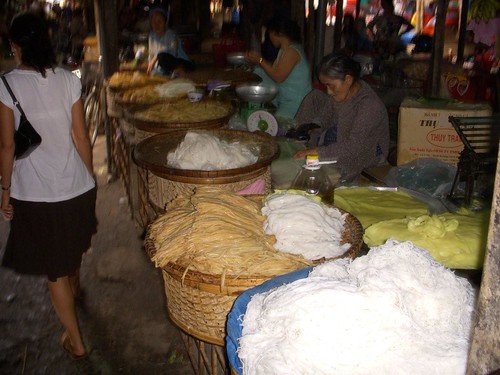
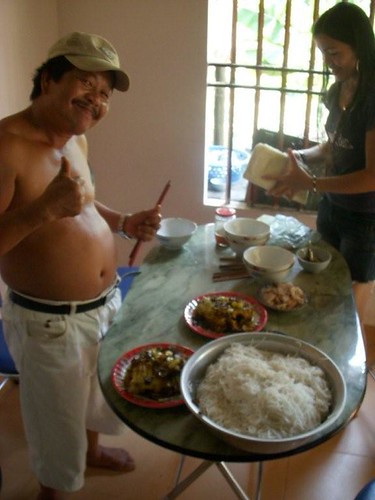
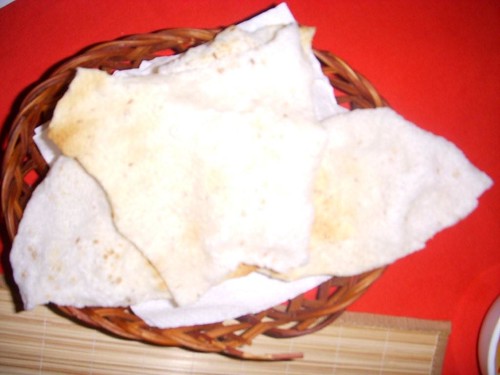
Rice is, of course, the main staple in Vietnam - not only as the rice that we know, but also rice paper, rice noodles, rice crepes, rice crackers, rice wine, rice gelatin - and we've probably forgotten a few others... The rice paper comes in 3 or 4 different forms; the soft fresh form for making fresh spring rolls; another variation for making fried spring rolls, and another which is grilled or fried, similar to pappadam, like a cracker, which is served as a side dish to accompany salads and certain appetizers...
Here are many of the rice noodle forms in the Hoi An market
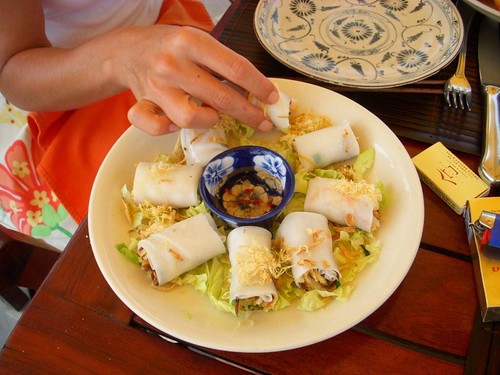
Rice, pappadam style
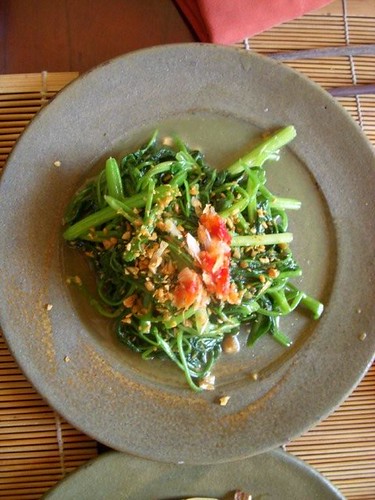
Vegetables are also very popular - the most common (almost as common as rice) is water spinach - a.k.a. Morning Glory - a semi-aquatic tropical plant which "flourishes naturally in waterways and does not require much if any care." It is most commonly served simply sauteed with garlic, garnished with some hot chili pepper, and maybe drizzled with a dash of nuoc mam (fish sauce) - it is absolutely delicious. Apparently it is expensive in the West because it needs to be washed repeatedly to get rid of all the mud, dirt, sand, silt and whatever else it grows in...
Morning Glory (water spinach), served at one of our favourite restaurants in Hoi An, called... Morning Glory! It is sauteed with large sweet garlic, and on the top, sprinkled with fried shallots, chopped fresh red chili pepper, and drizzled with fish sauce (nuoc mam) and a dash of sesame oil. It really is delish!
Eggplant is another popular vegetable - they use a variety of eggplant species - the most common is the Asian eggplant called 'white eggplant' - others include Japanese eggplant and occasionally Italian eggplant.
Fried white eggplant - another of our favorites
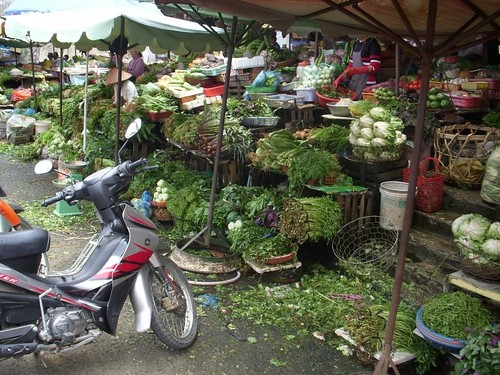
The markets are colorful, with colorful characters, and fresh vegetables everywhere...
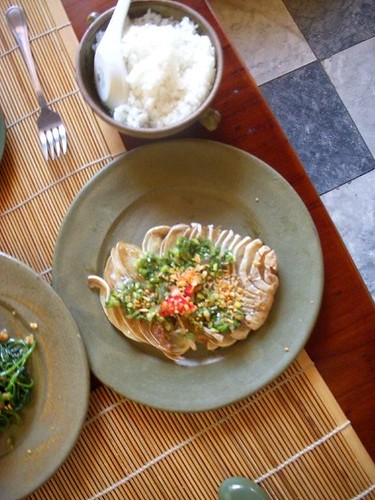
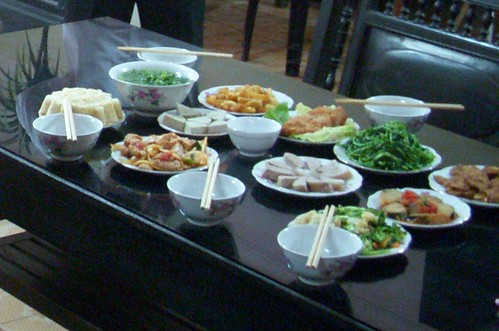
Tofu is another popular dish, made out of soybean. Tofu is popular among the many vegetarians in Vietnam - and is sometimes used as a meat-substitute, leading to some bizarre situations. When we visited a Buddhist orphanage in Hanoi, we were invited for 'vegetarian' lunch. When we sat down at the table, there were a dozen or so dishes that resembled various meat products, all made out of tofu (we worked out later) - for example, tofu shaped (and sliced) like fried squid, tofu-shaped like fried chicken pieces, tofu shaped liked pigs trotters etc. Each dish was artificially flavoured appropriately...
There are also various types of potato, including many types of sweet potato; yams, cassava... This appeared to be a regional phenomenon. We came across these mostly in the mountain regions of Central Highlands - particularly the markets in Dalat.
The Vietnamese consume lots of fruits too: dragon fruit, various banana species, mango, pomelo, tangerines, jack fruit, durian, papaya, rose apples, avocado, various melons, coconut... all widely available, looking fresh, luscious, inviting, and of course, very, very cheap!
Meat consumption is led by seafood on top of the list (in our experience) - from an incredible variety of fish, to shell-fish (shrimp of all sizes, oyster, abalone, clams, snails, lobster etc), eel, frog... Seafood was our preferred choice as often as possible, because it is often presented live in the outdoor markets in pots, or tanks, guaranteeing a certain level of freshness - particularly when the creature is butchered live right in front of you!


Live eels for sale in the market

Fried eel on the dinner table. Yum! (We actually ate this dish 5 times in three days in Dalat!)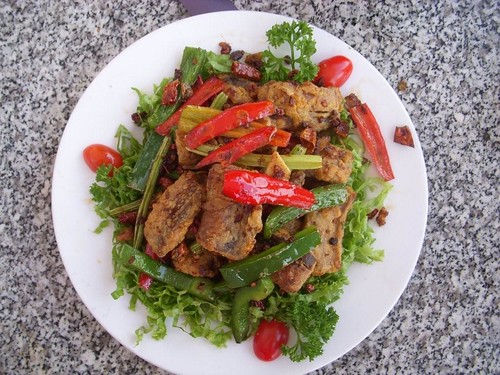


This is the common way that fresh seafood is presented in the restaurants - either on ice, or alive in tanks...
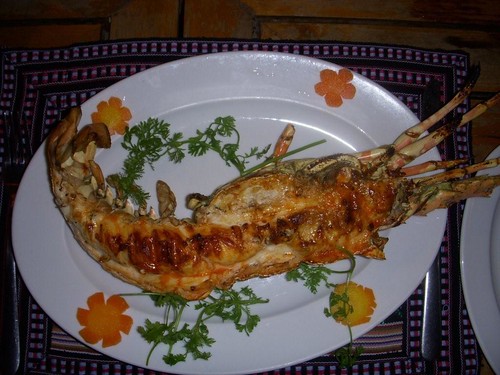
Lobster on the table in Mui Ne. We ordered this one from the tank on the street - and a few minutes later it came nicely grilled on the BBQ, seasoned with chili and garlic.

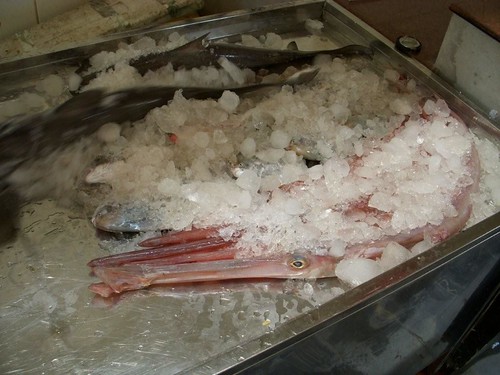
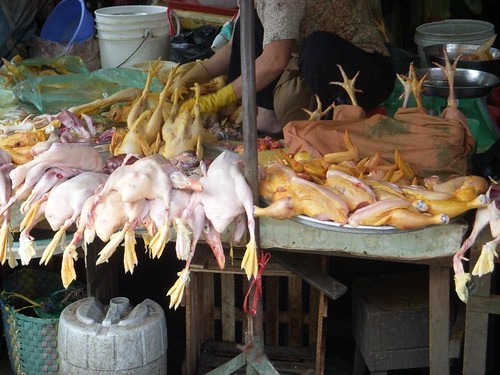
Other popular meat products include pork, chicken, and beef (we were told that 'beef' is often water buffalo which has outlived their usefulness dragging ploughs around the rice paddies - resulting in dark, tough meat called 'beef')... Much of the meat is available in the outdoor markets, with slabs of meat sitting on open wooden tables, in the heat, unrefrigerated, attracting flies... This is a common sight, which commonly suppressed our appetite for meat...
Here are some not-so-attractive chickens spread out on an open table at the Dalat market...
Vietnamese Flavours: Spices, Herbs, and Sauces
Yum! Roots - various types of ginger and fresh turmeric - are used heavily in Vietnamese dishes, and of course garlic is a given (the large, sweet garlic which they call French garlic, and the small, pungent garlic, referred to as Vietnamese garlic)...

The first basket on the left carries both ginger and turmeric - the lighter root on the left is ginger (Vietnamese use two types of ginger - the larger, smoother root, and the smaller, more irregular-shaped, more pungent ones, which you see in the basket on the left) To the right of the ginger is the fresh turmeric, used to add color and flavor. In the West we mostly use turmeric in powder form... Fresh turmeric is also apparently used to stop bleeding if you hurt yourself... such as, you know, if you fall face-first off your pushbike in the middle of the street... for example.
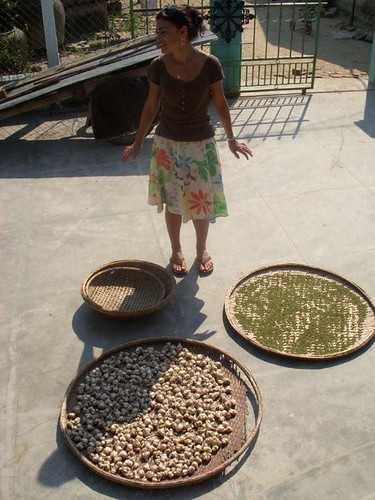
The large basket in the front contains small pungent Vietnamese garlic. This picture was taken in front of one of the village houses that we visited. The garlic is sun-dried for their own consumption...
Lemongrass is also widely used in broths and sauteed and simmered dishes
Vietnamese rely heavily on fresh herbs for flavoring - particularly mint, basil, coriander/cilantro, chives, and spring onion... Mustard Green is another which is served as a condiment, as well as eaten with food... Again, these herbs are widely available in all the markets, presented fresh, beautiful, and of course, cheap, cheap, cheap...
These herbs aren't very distinguishable from each other here, but there are heaps and heaps of fresh, inviting herbs from mint to basil, from cilantro/coriander to basil and mustard green...
As soy sauce is the main ingredient for Chinese food, Nuoc Mam (a pungent fish sauce based on anchovies) is used in almost every dish for flavouring, and in many cases is used as a substitute for salt... Tamarind, a sour, pungent fruit, is ground into a paste, diluted, and used as a sauce for many dishes. It adds a nice sweet & sour flavor. Soy sauce is usually used as a condiment presented in a small bowl, to accompany dishes as they are served, not as a cooking ingredient. Lime is also used as both a condiment and an ingredient in many dishes...
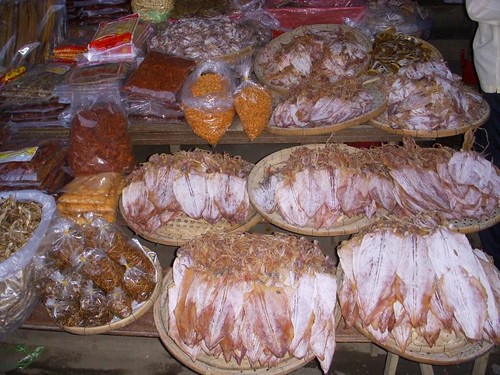
Dried shrimp, shrimp paste, dried squid, and certain dried shredded fish (fish flakes) are sometimes sprinkled over salads and some appetizers to add texture and flavour.

Here are various dried squid and fish products, together with some commonly used spices...
Various fresh hot chili - both green and red - are used as both garnishes and spicing/heat element in many dishes
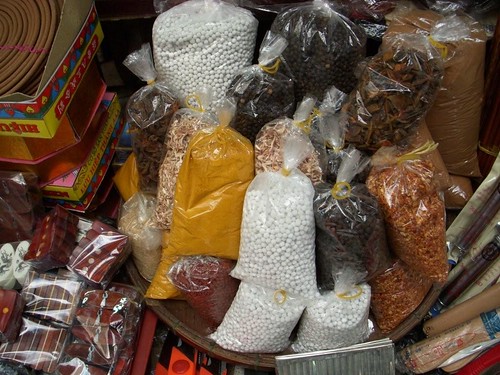
As far as dry spices goes, Chinese 5 Spices, nutmeg and both black and white pepper are the main spices. In some sauces and dishes, a dash or two of raw/brown sugar is used to balance the acidity and add flavors...
Here is a bundle of spices presented by one of the market vendors - dried turmeric, white pepper, black pepper, dried star anise, chili flakes...
Cooking Methods and Meal Types
As everywhere, Vietnamese have a bunch of different cooking methods and meal types - from soups, which they refer to as pho, to noodle dishes, from simmering hotpot dishes, to BBQ/grill - they have it all.
The most common dish is pho (brothy soup) which can be chicken-based (pho ga), beef (pho bo), seafood, vegetables, etc. The broth is the most important element - this is where the mastery/flavour comes into play... They simmer beef, chicken, and/or pig bones for hours (if not a day) The resulting broth is graded based on its flavor and clarity... Lemongrass, fish sauce, garlic, onion, are all used in various combinations to flavor the broth. The next main ingredient is the noodle - mainly thin rice noodle. The meat (chicken/beef etc) is placed on top of the broth, after it is poured in a bowl with noodles. Garnish is then placed on top - basil, mint, hot chili pepper, green/spring onion. Pho also shows regional distinction - the three best known are those in the North (Hanoi), Central Vietnam (Hue) and South (Saigon). Almost every block, in every town, city and village has a pho stand or store-front restaurant. People in Vietnam eat pho as both a meal and/or snack - it is widely available and very very cheap.
Noodles aren't only used in soups - as in Chinese cuisine, Vietnamese consume a lot of stir-fries, saute and salads based on noodles. Again, variations depends on regions and seasonal ingredients. For example, in Danang / Hoi An area, they are known for their Cau Lau - "A textured wheat noodles mixed with veggies, bits of toasted rice paper, slices of pork and a wonderful light sauce... Interesting trivia... supposedly true cau lau cannot be made outside of Hoi An as the water for the dish must come from the Ba Le well, an ancient water hole hidden away in surprising spot, behind some very suburban houses."
This was the best Cau Lau that we had in Hoi An - again, at Morning Glory Cafe. We tried it at some Western hotels and it sucked...

Hotpots - simmered dishes
This is similar to Japanese Shaba-Shaba. Basically, you have a pot filled with broth or water placed on a portable hotplate which sits on your table. Plates with meat (seafood, chicken, beef or pork), vegetables (bean sprouts, mustard green, spinach etc), herbs (mint, basil, coriander, chives, green onion) are provided - and since it is mainly for group dining, everyone participates, mixing the ingredients in the simmering broth, adding various flavouring elements such as hot chili pepper, fish sauce and chili paste...
Here we are dining with our Vietnamese friend Le Ly Hayslip, over a traditional seafood hotpot. As you can see, to the right, is your fresh mix seafood as the main ingredients. In the center is the hotplate over which the pot of broth sits, simmering. To the left, is the mixed vegetable plate to go into the hotpot last, and some fresh herbs to be eaten raw with the meal (it is not always obvious which is which). As always, there is a bowl of rice vermicelli noodles as an accompaniment. What you can't see is a bowl of fresh, hot, hot, hot chili which we sprinkle over our meal once it is served for that needed heat element!

Others
Grilling and BBQ-ing are commonly employed methods - both at home and in restaurants. Since flavoring is very important, items are usually marinated first...
Frying is also used here and there - the Vietnamese usually use peanut oil for frying.
Salads
Salads are heavily and commonly consumed in Vietnamese cultures - from delicious green mango salad to banana flower salad. They are all delicately flavored , texturised in layers with great care, and artfully presented. The main flavoring elements are mint, basil, coriander, lime and lime juice... In some cases, seafood, pork, chicken or beef are included - along with crushed peanuts and/or sesame oil.
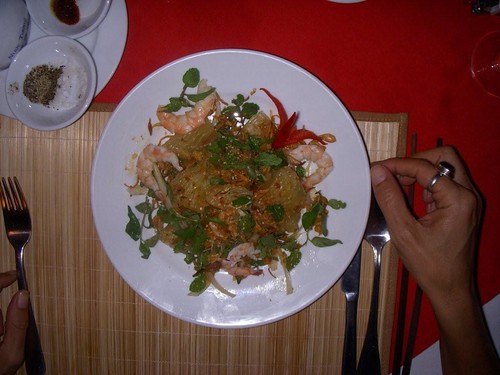
This is one of our many fave salads in Vietnam - Pomelo salad. It contains pomelo (a citrus fruit similar to grapefruit, but sweet), bean sprouts, spring onion, shrimp, mint, fried shallots, dried shrimp, hot chili pepper, a drizzle of lime juice, cane sugar, and fish sauce dressing. Absolutely yum.
Deserts and Baked Goods
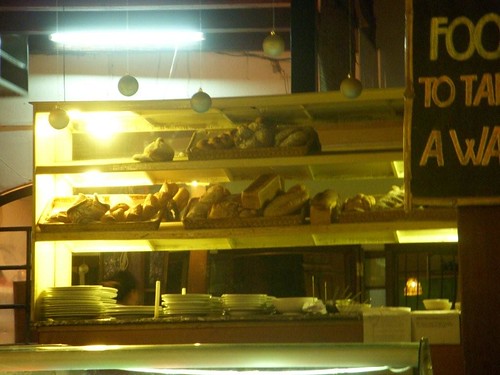
As far as the baked goods are concerned, the French influence is indubitably present. We have travelled extensively, but Vietnamese baguettes are by far the best we have ever come across. The breads, particularly the baguettes, are incredible - across the whole country.
Here is a not-so-great photo of the bakery at Cargo Club, one of our fave restaurants in Hoi An. Their baguettes were to die for...
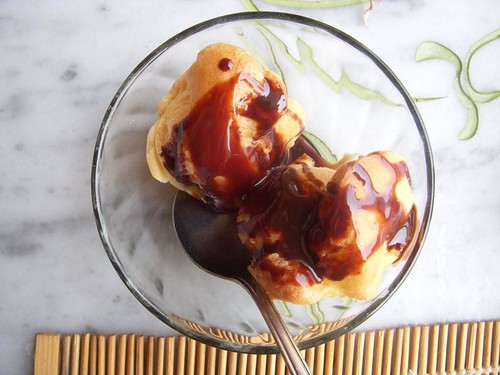
As far as traditional Vietnamese deserts are concerned, they can be broadly categorized as gelatinous - whether fried donuts filled with gelatinous fruits/fillings sold on the street corner, or steamed flavoured gelatin puddings in banana leaves...
Che is one of our favorite traditional Vietnamese street deserts - it's like a light pudding, with either corn, or mung bean, or tapioca base, served with lightly sweetened coconut milk and ice (the better restaurants always boasted of the fact that they made their own ice, and tried to convince us that we weren't eating the ice that we had just seen dragging down the street behind a motorbike!)
Here is the sweet corn and coconut milk che from Morning Glory Cafe.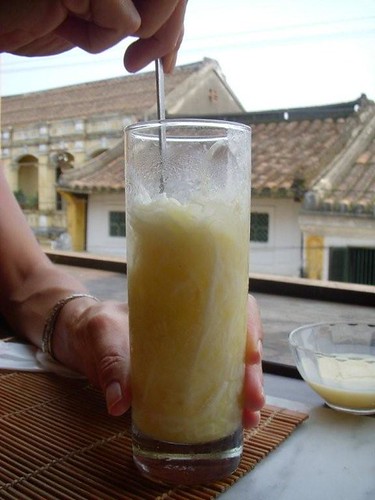
Presentation
Last but not least, the food here is always presented artfully, tastefully, and delicately. Every day we marvelled at the effort taken in presenting the food - whether it was a green mango salad sprinkled with golden brown crushed peanuts and decorated with fresh red chilli pepper sliced to represent a flower, or vegetables such as carrot, cucumber or tomato, cut and sculpted on the plate... Deep fried shallots are also frequently sprinkled over certain salads and appetizers for texture, flavour and color.
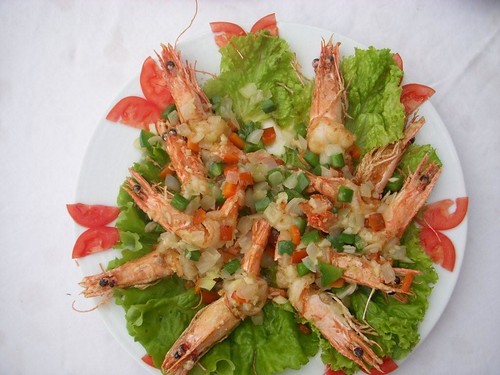
Obviously from the pictures of the food above, you already know that Vietnamese presentation of food is very artful and appetizing. Here is one more picture to convince you... Here is a dish of simply grilled shrimp. Simple it is not, right?!
Next Up
Our adventures in cooking class at Morning Glory Restaurant in Hoi An...